Residential water softeners remove calcium (Ca²⁺) and magnesium (Mg²⁺) ions from supply water using a bed of sulfonated polystyrene resin. The exchange happens at the molecular level: hardness ions displace sodium ions held on the resin surface, leaving the outgoing water with lower mineral content. This article explains the chemistry involved, how the resin bed is structured, and what limits its capacity over time.
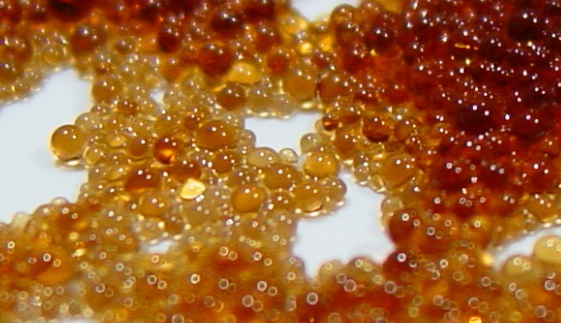
Ion-exchange resin beads — Wikimedia Commons / CC0
What the Resin Is Made Of
The beads inside a softener tank are a cross-linked styrene-divinylbenzene (DVB) copolymer carrying sulfonate functional groups (–SO₃⁻). Each bead is roughly 0.3–1.2 mm in diameter. The DVB content — typically 8% in standard residential resin — determines bead rigidity. Higher cross-linking increases resistance to physical breakdown and oxidation but reduces ion-exchange capacity per unit volume.
Sulfonated polystyrene is classified as a strong-acid cation (SAC) resin. The sulfonate groups remain ionized across the full pH range encountered in municipal and well water, which is why SAC resin handles both calcium/magnesium softening and partial iron removal without requiring pH adjustment.
Key Resin Properties
- Bead size: 0.3–1.2 mm (Gaussian distribution)
- Cross-link density: 8% DVB standard; 10% DVB for high-iron environments
- Functional group: Sulfonate (–SO₃⁻)
- Exchange form supplied: Sodium (Na⁺)
- Typical capacity: 30,000–32,000 grains per cubic foot in sodium form
- Operating pH range: 0–14 (functionally usable at all residential pH levels)
The Exchange Mechanism
When hard water enters the resin tank, it percolates through the bead bed. Calcium and magnesium ions carry a 2+ charge; sodium ions carry a 1+ charge. Because divalent cations are thermodynamically preferred by the sulfonate groups over monovalent cations, Ca²⁺ and Mg²⁺ displace Na⁺ from the exchange sites:
Exchange Reactions
- 2 R–SO₃⁻Na⁺ + Ca²⁺ → (R–SO₃⁻)₂Ca²⁺ + 2 Na⁺
- 2 R–SO₃⁻Na⁺ + Mg²⁺ → (R–SO₃⁻)₂Mg²⁺ + 2 Na⁺
The released sodium ions pass through the tank and into the household plumbing. The concentration of sodium added to softened water is proportional to the hardness removed: roughly 8 mg/L of sodium per 1 gpg of hardness removed. At typical Canadian hardness levels (150–300 mg/L as CaCO₃), the sodium contribution is within Health Canada's aesthetic objective of 200 mg/L for sodium in drinking water, though individuals on sodium-restricted diets should verify with their physician.

Ion exchange process diagram — Wikimedia Commons / Public domain
Resin Bed Depth and Flow Dynamics
A standard residential softener uses 0.75–2.0 cubic feet of resin, loaded into a pressure vessel (the mineral tank) with a gravel underbed for support. Water enters from the top distributor, flows downward through the resin bed, and exits through the bottom riser tube.
Contact time — how long water is in contact with resin — determines softening completeness. Most residential units are designed for a service flow rate of 5–7 gallons per minute per cubic foot of resin (gpm/ft³). Exceeding this rate during peak demand (simultaneous showers, laundry, dishwasher) can push water through before exchange is complete, resulting in hardness breakthrough.
Breakthrough and Exhaustion
As exchange sites become occupied by calcium and magnesium, the resin's ability to soften diminishes. Initially, only the top layer of the bed is exhausted; the lower layers still soften incoming water. Eventually, the exhaustion front reaches the bottom, and hardness ions begin appearing in the treated water — this is called breakthrough. At full exhaustion, the resin must be regenerated before further softening is possible.
Selectivity Sequence and Iron
SAC resin does not exchange all ions equally. The selectivity sequence for common cations in residential water is approximately:
Ba²⁺ > Pb²⁺ > Ca²⁺ > Mg²⁺ > K⁺ > NH₄⁺ > Na⁺ > H⁺
Ferrous iron (Fe²⁺, dissolved iron) exchanges onto the resin alongside calcium and magnesium. In moderate concentrations (below the softener manufacturer's rated iron limit, commonly 1–3 mg/L), the resin handles this during normal regeneration. At higher iron concentrations, iron can oxidize to ferric iron (Fe³⁺) inside the resin bed, forming deposits that block exchange sites permanently. This is the primary cause of resin fouling in Canadian well water areas where dissolved iron is elevated.
Signs of Resin Fouling
- Hardness breakthrough occurring earlier than the set capacity suggests
- Discoloured (orange or brown) water after regeneration
- Resin beads clumped or darkened when inspected
- Increased salt consumption with declining softening output
Expected Resin Lifespan
Under typical municipal water conditions in Canada — chlorinated, with hardness in the moderate-to-hard range — residential resin lasts approximately 10–15 years. The main degradation mechanisms are:
- Osmotic shock: Repeated swelling and contraction during regeneration slowly fragments beads.
- Oxidative attack: Free chlorine in municipal water degrades the DVB cross-links over time. Most major Canadian municipalities maintain residual chlorine within the range that allows acceptable resin life with standard 8% DVB resin.
- Physical attrition: Excessive backwash flow rates physically abrade beads.
- Iron fouling: As described above, particularly relevant for well water users in rural Ontario, Alberta, and Manitoba.
Resin capacity can be tested using a hardness test kit on the softener outlet after a timed service period, compared against the rated capacity. Capacity falling below 60–70% of original specifications is a common replacement threshold.