The brine tank holds the salt supply that makes regeneration possible. Unlike the resin tank, which requires little routine attention beyond periodic resin replacement, the brine tank needs regular inspection. Salt does not simply dissolve cleanly and consistently — it can bridge, mush, or accumulate insoluble residues that interfere with brine production. Equally important is correctly programming the hardness grain setting on the control valve, since an incorrect value causes either hard water breakthrough or excessive salt use.

Brine tank in a water softening installation — Wikimedia Commons / Public domain
How the Brine Tank Functions
At the start of each service cycle, the brine tank contains water at the bottom — the "brine well" — covered by dry salt. During the days between regenerations, water slowly dissolves salt from the bottom up, creating a saturated sodium chloride solution (approximately 26% NaCl by weight at room temperature, or about 315 g/L). When regeneration begins, the control valve draws this brine into the resin tank through an injector that dilutes it to the 10–15% working concentration.
After brine draw, the control valve refills the brine tank with a metered volume of fresh water. This sits below the remaining salt, dissolving it gradually in preparation for the next regeneration. The cycle then repeats.
Salt Bridge: Identification and Removal
A salt bridge forms when a hardened crust of salt spans the interior of the brine tank at some height above the water level, leaving a hollow space below. From the outside, the tank appears to have adequate salt. However, no salt is dissolving into the water — the brine is depleted — and the next regeneration proceeds with plain water rather than brine, leaving the resin uncharged.
How to Check for a Salt Bridge
- Remove the tank cover and observe the apparent salt level.
- Press down gently on the salt surface with a broom handle or wooden dowel.
- If the salt surface is firm but gives way when pressed, revealing a void below, a bridge is present.
- If there is resistance throughout, the tank has solid salt with normal water below (no bridge).
Removing a Salt Bridge
Break up the bridge by working the dowel around the perimeter and through the crust. Avoid striking the control valve, brine float, or overflow tube. Once broken, the salt falls into the water below and begins dissolving. Allow 4–6 hours before initiating a manual regeneration to give the brine time to reach useful concentration.
What Causes Salt Bridges
- High ambient humidity: Common in Canadian basements during summer. Salt absorbs moisture, partially dissolves, then re-crystallizes as humidity drops, bonding grains together.
- Overfilling the tank: Salt packed tightly to the top compacts over time.
- Salt type: Solar salt pellets (evaporated) resist bridging better than rock salt, which contains insoluble minerals that promote crusting.
- Infrequent use: Salt sitting undisturbed for weeks consolidates more readily.
Salt Mushing
Mushing is distinct from bridging. It occurs when salt pellets dissolve unevenly, leaving a thick sludge of undissolved crystals and insoluble impurities at the bottom of the tank. This sludge can block the brine pickup tube, restricting brine draw during regeneration. Unlike a bridge, mushing is not visible from above — the salt appears normal.
Signs of Mushing
- Hard water despite normal salt level in the tank
- Lower-than-expected brine draw volume (check control valve service records)
- Sediment visible when removing the brine pickup tube
Corrective Action
Disconnect the brine pickup tube and remove all remaining salt. Use warm water to dissolve the sludge, and flush the tank through the drain. Check the pickup tube screen for blockage, rinse it clean, and reload fresh salt. Using pelletized solar salt rather than rock salt reduces mushing frequency significantly, as solar salt has lower impurity content.
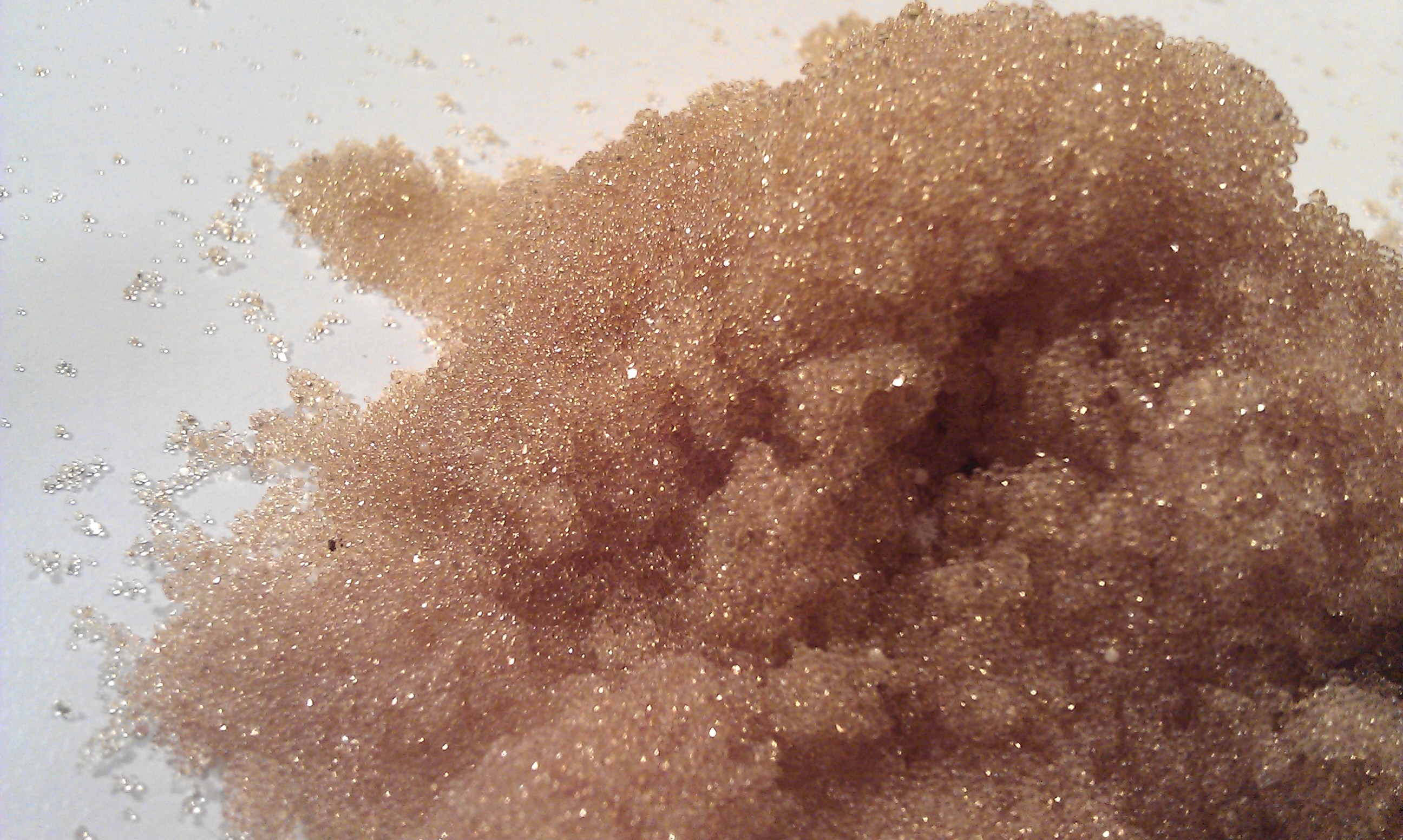
Ion exchange resin beads that brine regeneration restores — Wikimedia Commons / CC BY-SA 3.0
Routine Maintenance Schedule
| Task | Frequency | Notes |
|---|---|---|
| Check salt level | Monthly | Keep salt at least one-third full; do not overfill above two-thirds |
| Test for salt bridge | Monthly | Probe with dowel, especially after humid summer months |
| Inspect brine pickup tube | Every 6 months | Remove, rinse screen, check for hairline cracks |
| Full tank cleanout | Every 1–2 years | Remove all salt, flush sludge, rinse tank interior |
| Test treated water hardness | Every 3–6 months | Using a hardness test kit at a post-softener tap |
| Check control valve O-rings | Every 2–3 years | Signs: water around valve body, incomplete cycle sounds |
Setting Hardness Grain Values on the Controller
The control head stores a hardness value (in grains per US gallon, gpg) that it uses — combined with measured water volume — to calculate when to regenerate. Entering the correct value is essential. An underestimate causes breakthrough; an overestimate causes unnecessary salt consumption and excessive brine discharge.
Step 1 — Measure Your Water Hardness
The starting point is an accurate hardness measurement. Options available to Canadian homeowners:
- Municipal water quality report: Most Canadian water utilities publish annual water quality reports with hardness data. Reports are typically available on the utility's website. Values are usually expressed in mg/L as CaCO₃ — divide by 17.1 to convert to gpg.
- Hardness test kit: Titration drop-count kits (available at water treatment retailers across Canada) provide a reading in gpg or mg/L directly at the tap.
- Laboratory analysis: For well water, a certified laboratory test provides precise hardness alongside iron, manganese, pH, and bacteria results. Some provincial programs subsidize private well testing.
Step 2 — Account for Iron
If your water contains dissolved iron (ferrous iron), add the iron compensation to the hardness value before entering it into the controller. A standard rule used by Canadian water treatment technicians:
Iron Compensation Calculation
Adjusted Hardness (gpg) = Measured Hardness (gpg) + (Iron mg/L × 4)
Example: 12 gpg hardness + 2 mg/L iron
Adjusted = 12 + (2 × 4) = 20 gpg
Step 3 — Enter the Value into the Controller
Most residential control heads (Fleck, Clack, Autotrol, and equivalent brands distributed in Canada) access hardness settings through a programming sequence accessed by holding the Set or Extra Cycle button for several seconds. Consult the specific model's manual for the exact sequence. The value entered should be the adjusted hardness from Step 2.
Setting the Regeneration Day Reserve
Demand-initiated controllers also allow setting the number of reserve gallons to maintain before triggering regeneration. This reserve ensures that water use on the day regeneration is scheduled does not exhaust the resin before the overnight cycle runs. A common setting is one day's worth of household consumption in gallons. For a Canadian family of four using approximately 80–100 gallons per day, a reserve of 80–100 gallons is typical.
Salt Type Selection
| Salt Type | Purity | Bridge Risk | Mushing Risk | Notes |
|---|---|---|---|---|
| Solar salt pellets (evaporated) | 99.6–99.9% | Low | Low | Preferred for most residential use |
| Block salt | ~99.5% | Very low | Low | Requires tank designed for block use |
| Rock salt | 95–98% | Moderate | High | Low cost; higher insoluble content increases sludge |
| Potassium chloride (KCl) | ~99% | Low | Low | Used where sodium reduction in treated water is desired |
Potassium chloride is used by some Canadian households where residents are on sodium-restricted diets, or where discharge to a septic system is a concern. Potassium chloride is generally more expensive than sodium chloride and is available at most hardware and water treatment retailers in Canada.